
device detection

Wednesday, October 21, 2026 9:00 AM
How likely is your traffic to be from real humans?
How to handle the rise of bots and autonomous agents
Human Confidence tells you, in one word and in real time, how sure you can be that a person is viewing the page.

Wednesday, September 16, 2026 9:00 AM
Your ads have an audience. Does it have a pulse?
Autonomous AI agents browse in real browsers, on real devices, from real addresses. Here is how to tell whether a human is involved.
There is now a third kind of visitor, and it fits neither box. Autonomous AI agents drive genuine Chrome, on genuine laptops, over genuine residential connections, so nothing in the request is fake and every check you already run passes. HumanConfidence reads eight device and network signals in one call and returns High, Medium, or Low, with the recipe published so you can check the working yourself.
Wednesday, July 29, 2026 3:30 PM
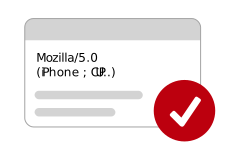
Why preserving the original User-Agent matters
Lowercasing a User-Agent removes information that no detection engine can recover
Applications, proxies, and analytics platforms often lowercase or otherwise normalize User-Agent strings before they are processed. This blog explains why a User-Agent is structured data rather than ordinary text, what is lost when it is modified, and the best practice for keeping device detection accurate.

Tuesday, July 28, 2026 1:30 PM
Naver's robots and crawlers
Research into Naver's approach to scraping web content
This blog explains how Naver’s web crawlers, including Yeti, Ads-Naver, and Blueno, interact with website content. It outlines their different roles, the crawler usage values assigned to each, and how they affect content visibility across Naver’s search and services.

Tuesday, July 7, 2026 1:30 PM
When is CTV not CTV?
Nearly 5% of inventory sold as CTV isn't CTV at all
What actually counts as connected TV? We checked more than 11 million OpenRTB impressions with Device Detection and found nearly 5% of inventory sold as CTV isn't CTV at all, mislabeling that could be costing advertisers close to $2 billion a year.
Tuesday, June 16, 2026 5:00 PM
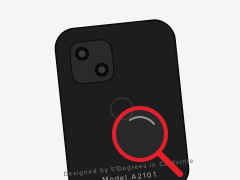
Apple model number lookup: A-code to iPhone and iPad
Every A-code 51Degrees recognises, in one table.
Your iPhone or iPad has an AXXXX code printed on the back or buried in Settings. It tells you which model the device is, but only if you have the mapping. Here is the full A-code to device-name reference 51Degrees uses, along with a note on how Apple's three different identifiers fit together and where to find each one.

Tuesday, June 16, 2026 1:30 PM
DuckDuckGo's Robots and Crawlers
Research into DuckDuckGo's approach to scraping web content
This blog explains how DuckDuckGo’s web crawlers, including DuckDuckBot and DuckAssistBot, interact with website content. It outlines their different roles, how they follow robots.txt directives, and the management of crawler access and content visibility.

Monday, March 30, 2026 5:30 PM
Apple Web Crawler
How Applebot and Apple crawlers shape visibility across Apple’s ecosystem
This blog explains how Apple’s web crawlers, including Applebot and Applebot-Extended, work across its ecosystem to surface content in Siri, Spotlight, and Safari. It outlines the different crawlers, their purposes—such as search indexing, feed updates, and AI training—and how enabling them can improve content visibility, traffic, and control over how content is used, particularly in generative AI.

Tuesday, March 3, 2026 5:30 PM
Perplexity's robots and crawlers
Research into Perplexity's approach to scraping web content
Find out how we classify Perplexity's AI web crawlers.

Wednesday, February 18, 2026 5:30 PM
Automatic Data Updates With 51Degrees
Keep your detection engine accurate, synchronized, and maintenance-free with intelligent automatic data file updates.
Automatic data updates in the 51Degrees Pipeline API ensure device detection engines always use the latest data without manual intervention. With configurable polling, validation, and safe file replacement, this feature minimizes maintenance, prevents stale detections, and scales efficiently across single servers or large clusters.